farewell, hello
Friends, here are two new black shabbat playlists—loose gatherings of songs to ferry you along toward your gods. Two, because I have them at the ready and have been so irregular with sending anything out.
The lists are on Qobuz, so if Spotify (or some other low grade platform) is still stringing you along with its cheapskate approach to artist payments and sodden disinterest in sound quality, you can refer to the song lists below, search up the songs and listen on whatever platform you are paying good money for. Tedious!
black shabbat #239
“Musica Callada: Book 1, V. ([M.M.] crochet = 54),” Don Byron and Aruan Ortiz, from Random Dances and (A)tonalities, 2018.
“Prelude To a Heartbreak,” Marta Sánchez, from Perpetual Void, 2024.
“Perfection’s Loneliness,” Dan Weiss, from Unclassified Affections, 2025.
“Perigeo,” Angelika Niescier, from Chicago Tapes, 2026.
“In Turn,” Michael Formanek, from As Things Do, 2023.
“Along the Malecon,” “The Three of Us, Floating,” “Iris Murdoch,” Adam O’Farrill, from Sea Triptych, 2026.
“Oh Great Be the Lake,” Ben Lamar Gay, Open Arms to Open Us, 2021.
“At the Purchaser’s Option,” Ragazze Quartet, from But Not My Soul, 2024.
“Lakbay Lullaby,” Susie Ibarra, from Folklorico, 2004.
“Glory,” Wayne Horvitz, Butch Morris, Bobby Previte, from Nine Below Zero, 1986.
“Nij polze idu babo,” Every, from Tried in the Fire, 2026.
“Song,” Marilyn Crispell and Anders Jormin, from Memento, 2026.
black shabbat #240
“Snowing in the Woods,” Marta Sánchez, from For the Space You Left, 2026.
“An Invitation to Disappear,” Kris Davis, from The Solastalgia Suite, 2026.
“Abandon,” Dave Adewumi, from The Flame Beneath the Silence, 2026.
“This Earth Would Have No Charms for Me,” Chris Potter, from Alive With Ghosts Today, 2026.
“Revue,” The Hemphill Stringtet, from The Hemphill Stringtet Plays the Music of Julius Hemphill, 2025.
“Oo long!” Tomeka Reid, from dance! skip! hop!, 2026.
“The Proximity of Clouds,” Adam O’Farrill, from HUESO, 2024.
“A Moment to Be Free,” Yazz Ahmed, from Shinrin-Yoku, 2026.
“Insisting,” Harriet Tubman with Georgia Anne Muldrow, from Electrical Field of Love, 2026.
“Jina,” Mahan Mirarab, from Unspoken, 2026.
“Nassam Alayna-l’Hawa,” George, from Looking for Consonance, 2026.
“Devotion,” Abdullah Ibrahim, from The Balance, 2019.
farewell, hello
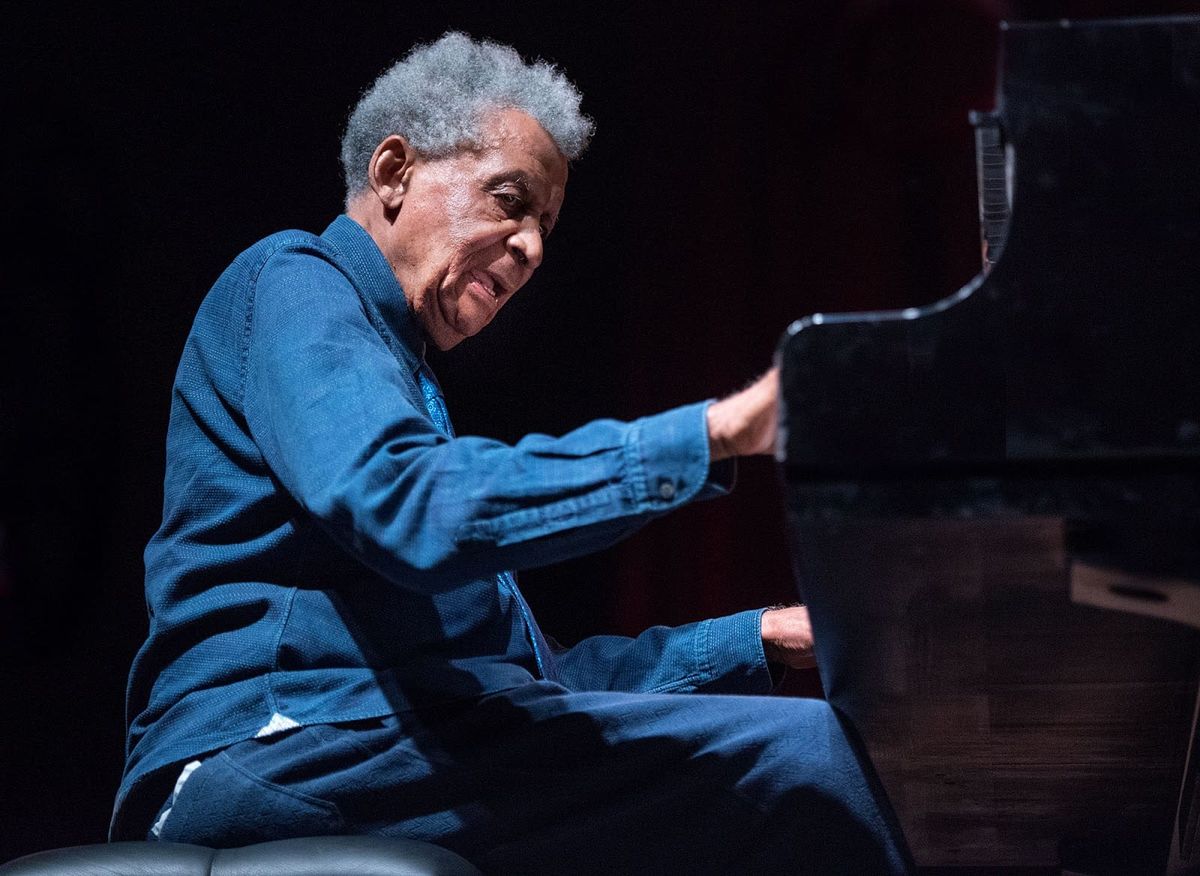
The great South African pianist and composer Abdullah Ibrahim passed away last week. His music has been a touchstone across many decades now, and it will continue to be grounding for me. Ibrahims last 2 solo records are each marvels of sound and silence—deliberate, exquisite, compressed, spacious—as though he is seeking as few notes as possible to speak, to play these compositions that are such a profound part of his being it sounds like he is sitting with old friends who don't need to say much to have a deep time together. I recommend you listen to Solotude and Dream Time in their entirety, over and over for days and nights. And/or explore the rest of his catalogue, everything he has left us with.
misreading walter benjamin’s theses anew
We’re well in to “Trump 2.0,” approaching the implementation of page 923 of Project 2025, etc., and a fair number of people are asking “How did we get here?” The question often registers as disingenuous, imo, as though where we are has come as a surprise, often a surprise with a knowing laconism attached to it—eg, “didn’t think I would ever see a secret police in the U.S., but, well, here we are.” Such quips elide the blatant facts; facts span the centuries. There’s no surprise to it; perhaps we just like to think ourselves exceptional on all the levels, living in an exceptional time. Yes, of course, today is not yesterday, when I wasn’t born. Nothing is all the same. Today’s fascisms are not Hitler’s, though some aspects are Hitleresque. And we don’t have so much a secret police as an open secret police.
But, yet, also, a reasonable enough question. If one studies histories, it’s possible to develop certain predictive capacities that are useful in the seeing of whatever is coming. Yes, history has its repetitions, but perhaps what it has more of is continuities, ruptures, clawbacks, struggles, and the writing of all these. And death, the memory that constitutes history, which is in the future. We too can be angels of history, turned backward to face the storm, staring down the pile of debris but not seeing what is behind us (the future), unless we have eyes in the back of our heads. Or you, me, angels, could we do an about-face and move on, carrying all the debris on our backs rather than hovering over it, letting it push us around, backward?
Until again,
David T